
Furnished Housing for Travel Nurses in Atlanta: What to Look For
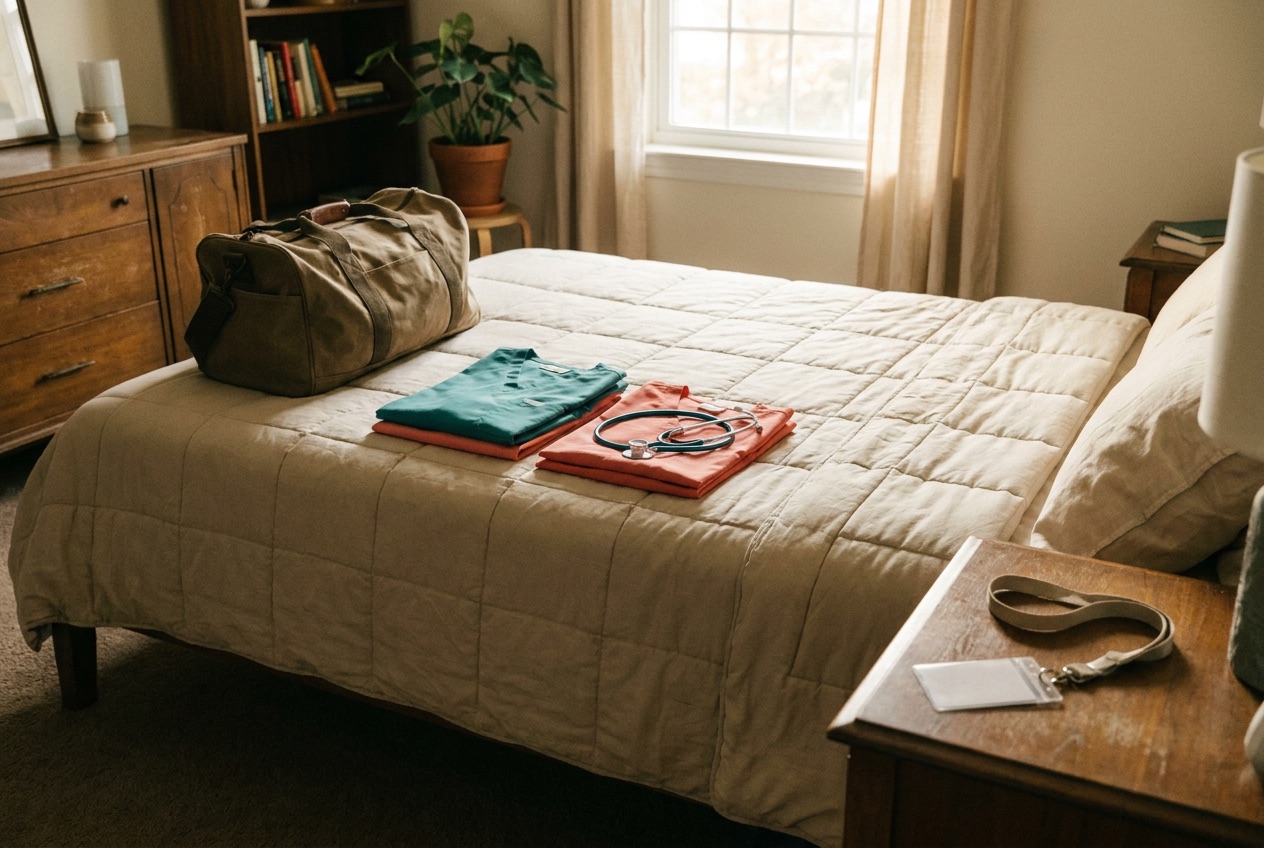
Good travel nurse housing in Atlanta is furnished, flexible on term, close enough to your hospital that a night shift doesn't become a two-hour ordeal, and verifiable before you wire money from another state. A thirteen-week contract doesn't fit a twelve-month lease, so furnished and flexible beats cheap and locked-in almost every time. The real trick is confirming a place is livable when you can't walk through it yourself.
What a thirteen-week contract does to the housing math
A standard assignment runs about thirteen weeks, roughly three months, and that number quietly breaks the normal way people rent. A twelve-month apartment lease assumes you'll be there for a year, and if you sign one for a three-month contract you're on the hook for the other nine, or you're subletting to a stranger your landlord has to approve, on a timeline set by your contract and not your convenience. Neither is a good use of the energy you're supposed to be spending on a demanding job in an unfamiliar hospital.
So the math changes. Instead of chasing the lowest possible monthly rent and accepting a year of obligation, you're solving for a place that matches your actual dates, comes ready to live in, and lets you extend if the contract does. Contracts extend all the time, and they end early sometimes too, so the flexibility to add four weeks or leave on schedule without a penalty is worth real money. A furnished room on a short term that renews cleanly is built for exactly this, and a bare apartment simply isn't.
There's a timing wrinkle too. Assignments often get confirmed on short notice, which means you're frequently housing-hunting on a two-week runway, not a leisurely one. That compresses everything and makes the ready-to-live-in option even more valuable, because you don't have three weeks to wait on furniture delivery and an internet install before your first shift. The people who handle travel nurse housing in Atlanta well are usually the ones who accept that reality and solve for speed and certainty over squeezing out the last few dollars of monthly rent, because a slightly higher rate that lets you start work on day one beats a cheaper place you can't actually live in yet.
Why furnished and flexible beats cheap and locked-in
The temptation is to find the cheapest unfurnished place and make it work. On paper it looks like savings. In practice, furnishing a three-month stay means either hauling a carload of your own things across several states or buying a bed, a couch, a table, and a kitchen's worth of gear you'll sell at a loss in twelve weeks. Add power, gas, water, and an internet install with its own wait and its own contract, and the cheap apartment quietly costs more than the furnished room while demanding hours you don't have.
Furnished and flexible also protects you when the contract itself moves. If your assignment gets cut short, you don't want to be the one begging a landlord to let you out of nine months. If it extends, you don't want to be scrambling for a second place because the first one's lease ran out on a fixed date. A setup designed for contract workers absorbs both of those without drama. That's not a luxury for a travel nurse, it's the whole point, and it's why so many nurses stop fighting the apartment model and rent a furnished room instead.
What to verify before you wire a deposit from three states away
This is the part that matters most, because the ugliest travel-housing stories all start the same way: money sent for a place that wasn't what the pictures promised, or wasn't real at all. Verify before you pay. Ask for a live video walkthrough, not a photo set, a real-time call where someone walks the actual room and house while you watch, so you know the pictures aren't three years old or borrowed from somewhere nicer. If nobody will get on a video call to show you the room, that alone is your answer.
Confirm the exact term in writing, your real start and end dates, the total cost, the deposit, and precisely what the deposit covers and how you get it back. Ask what's included down to the specifics, because all-inclusive should mean utilities and wifi are already running when you arrive, not a bill that shows up later. Ask who you contact when something breaks and how fast they respond, because on a night-shift schedule a broken air conditioner in July is not a next-week problem. And use a traceable payment method with some recourse, never a wire or a gift card to someone you've only texted. A legitimate operator expects these questions and answers them without flinching. Evasion is the red flag, every time.
A couple of extra checks are worth the ten minutes. Search the address itself, not just the listing, and make sure the photos match a real place rather than a stock apartment reused across a dozen ads. Ask how many people share the house and how the room locks, because on a shared setup those two facts shape your daily life more than almost anything else. And confirm the cancellation terms in writing before you send money, since assignments fall through and you don't want your deposit vanishing with the contract. None of this is paranoid. It's the normal diligence of committing to a place you've never stood inside, from a state away, on a timeline someone else set, and a real operator will respect you for doing it.
Commute realities for travel nurse housing in Atlanta from the west side
Atlanta's hospitals cluster in a few areas, and the map does not care about your good intentions. The big-name systems sit around Midtown, Emory's campus toward Decatur on the east side, and the northern suburbs, with more scattered around the perimeter. If you're staying on the west side, in Douglasville, Austell, Lithia Springs, or Mableton, your commute lives and dies on I-20 heading into town and on whether you ever have to touch I-285, the perimeter highway that rings the city and backs up hard at rush hour.
Here's the honest part. A west-side base is genuinely convenient for hospitals on the western and southwestern side of the metro and for anything you can reach on I-20 before the worst of the congestion. It's a longer haul to Emory and the far northern systems, especially if your shift change dumps you onto I-285 at peak. The saving grace for nurses is the schedule: a lot of nursing shifts start and end off the standard nine-to-five peak, so a 7 PM start or a 7 AM end can miss the traffic that would wreck a normal commuter. Before you commit, map your specific hospital against your specific shift times, not the abstract distance. Fifteen miles at 3 AM and fifteen miles at 5 PM are completely different drives, and the second one will change how you feel about the whole assignment.
One practical move before you accept a place: pull up your exact route at your exact shift-change times using live traffic, on a weekday, and look at the real drive rather than the optimistic one. Do it for the morning you'd come home and the evening you'd head in, because Atlanta traffic is directional and lopsided, and a route that's clear one way can be a parking lot the other. If your hospital sits inside the perimeter and you're basing outside it, that I-285 crossing is the piece to scrutinize hardest, since it's where the west-side advantage either holds up or falls apart. Nurses who do this small bit of homework rarely end up shocked by their commute, and the ones who skip it sometimes spend twelve weeks regretting a place that looked perfect on a map.
Thinking about the stipend without pretending to know your numbers
Most travel contracts include a housing stipend, and how you use it is a real decision, but the specific dollar figures are yours and your agency's, not something anyone should quote at you off a blog. The useful way to think about it is total cost of being housed, not just rent. A furnished all-inclusive room that folds utilities, wifi, and furniture into one number is easy to measure against a stipend, because there's one figure and no surprises. A bare apartment scatters the real cost across rent, five utility accounts, an internet contract, and furniture you buy and abandon, which makes it much harder to know whether you actually came out ahead.
The pattern worth noticing is that the simplest housing to budget against a stipend is usually the all-inclusive furnished option, precisely because nothing hides. You know the number before you arrive and it doesn't move. Whatever your stipend is, a single predictable housing cost lets you see clearly what you keep, and keeping more of the stipend is the entire financial reason travel nursing pays the way it does. Run your own numbers, but run them on the full cost, not the headline rent, or you'll fool yourself into the apartment that looked cheaper and wasn't.
Why do travel nurses so often end up in co-living?
Ask around and you'll find a lot of travel nurses in co-living or private-room furnished setups rather than solo apartments, and it isn't an accident. The model fits the job. It's furnished, so you arrive with a suitcase. The term is flexible, so it bends with the contract. The cost is one predictable number, so it's easy to run against a stipend. There's also a quieter benefit that matters more than people expect on a thirteen-week assignment in an unfamiliar city: you're not living completely alone. A shared house means a few other people around, some of them often other traveling professionals on their own contracts, which can make a strange city feel a little less strange during a stretch of demanding shifts. And the good ones are set up for exactly the person who works while the rest of the house sleeps, which is the piece that actually makes or breaks it.
A good setup for a night-shift nurse means a room that stays dark and quiet when you need to sleep through daylight, ideally with real blackout coverage on the windows and housemates who understand somebody in the house is on an opposite clock. It means a real parking spot you can count on after a twelve-hour shift, not a nightly street-parking hunt. It means wifi that genuinely works for video calls home and streaming on your days off, not a connection that four people crush at once. Those three things, quiet dark sleep, reliable parking, real internet, are what separate a place that supports a hard job from a place that quietly makes it harder. If you're weighing travel nurse housing in Atlanta, weigh those first. We run furnished co-living homes on the west side with contract workers squarely in mind, and those are the details we hear about most, because they're the ones that decide whether an assignment feels survivable.