
Why Themed Stays Work for Date Nights
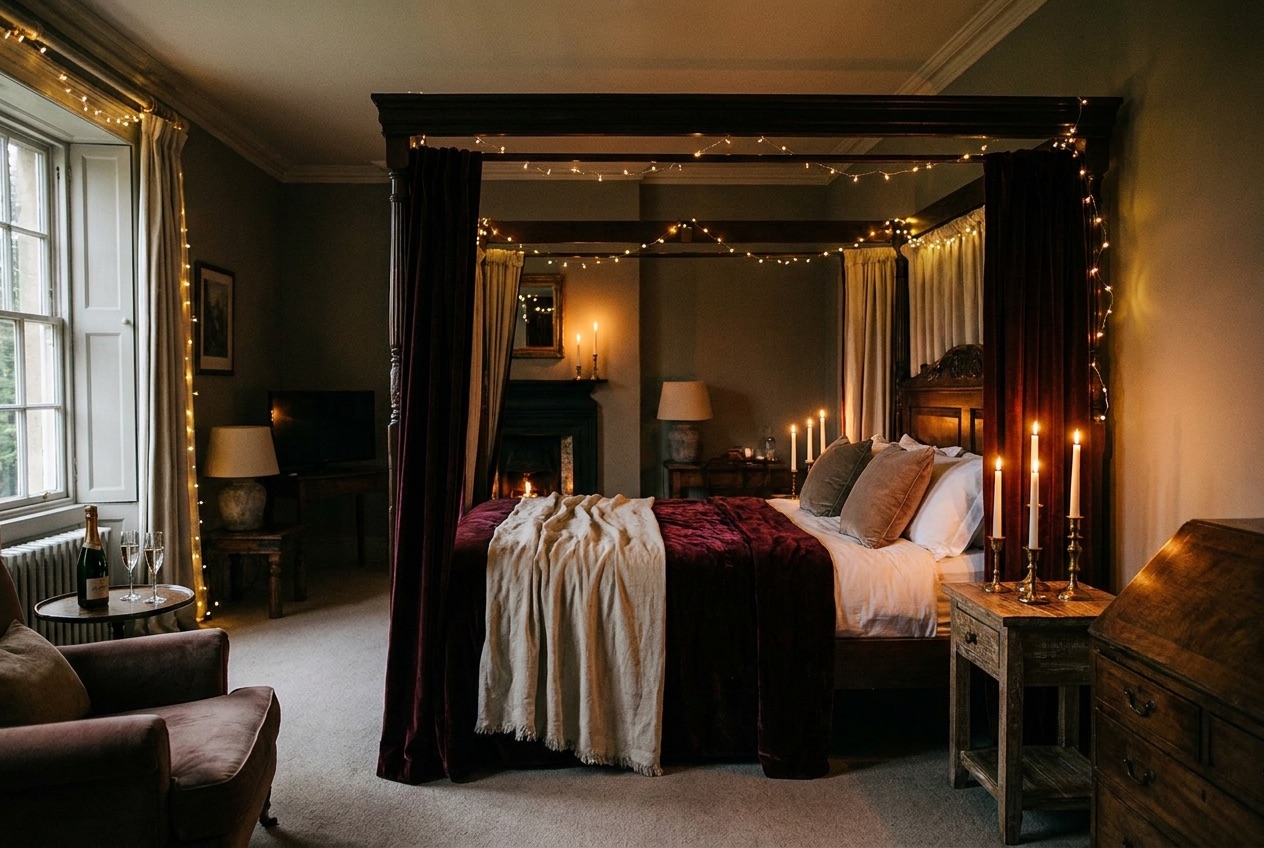
Themed stays work for date nights because they do two things a restaurant cannot. They hand you genuine novelty, what long-term couples run out of, and they buy you uninterrupted time in a space designed for just the two of you. Dinner and a movie is fine, but it ends at ten and drops you back in the same living room with the same laundry. A designed overnight resets things.
Novelty is the thing you actually ran out of
The problem with date night for couples who have been together a while is not love, it is sameness. You have been to the good restaurants. You have seen the movie. The Friday routine has calcified into something comfortable and slightly invisible, where you are together but not really paying attention, because nothing about the evening asks you to. Comfort is lovely and it is also where relationships go quietly on autopilot, and you can feel it when it happens.
Novelty is the antidote, and there is a real reason for it. A new environment makes your brain pay attention again, the way the first few days of a vacation feel sharper and slower than normal life. A themed room does that on purpose. When you walk into a space that looks like nothing your daily life contains, you both perk up, you notice each other noticing, and the conversation stops being logistics about the kids and starts being the kind of talk you had before the logistics took over.
That is the quiet argument for spending on themed stays and designed experiences instead of another dinner. The dinner is gone by Saturday morning and you will not remember which one it was. The night you spent somewhere deliberately strange and beautiful sticks, because your memory files new and vivid things and discards the routine. You are not really buying a room. You are buying a memory that will still be doing work months later, which is a better deal than it looks on the invoice.
Undivided attention is the real product
The most underrated feature of a stay, themed or not, is that it removes the exits. At home there is always something to get up and do. A dish in the sink, a phone charging on the counter, a load of laundry that will nag at one of you until it is folded. Home is a to-do list wearing the costume of a relaxing evening, and part of your attention is always half-committed to the list even when you are trying to be present.
A room that is not yours has none of your chores in it. There is nothing to fix, nothing to tidy, nothing that belongs to your ordinary responsibilities, so the attention you would normally spend managing your own house is suddenly free and pointed at each other. Couples tell us this without quite having words for it. They booked the theme and what they remember is that they actually talked for three hours, which almost never happens at home because home keeps interrupting.
Phones are the other exit, and a good stay makes you want to put them down without anyone lecturing you about it. When the space itself is interesting, the pull to scroll drops, because the room is more compelling than the feed. That is a design goal, not an accident. The details are there to hold your attention in the room and on the person across from you, which is the entire point of the exercise and the thing a dinner reservation cannot manufacture.
Why leaving the house matters even twenty minutes away
People assume a getaway has to be far to count, and it does not. The psychological shift happens at the door, not at mile two hundred. The moment you are somewhere that is not home, the mental load of your household stops sitting on your shoulders, and it turns out that most of that weight was proximity. You cannot see the unfinished projects or hear the dryer running. You are off duty in a way you never quite are inside your own walls.
That is why a stay twenty minutes from your driveway can feel more restorative than it has any right to. We are just west of Atlanta near the I-20 corridor, and plenty of our date-night guests live close enough that the drive is barely a drive. They come anyway, and they are not being wasteful. They understand that the distance is not the point. The threshold is the point, and crossing it, even a short way, is what lets both of you actually exhale.
There is a practical bonus to staying close, too. A local overnight is cheap in every currency except money. No airport, no packing crisis, no full day of travel bracketing a short trip, no elaborate childcare arrangement stretched across days. You can drop the kids at grandma's after dinner, be checked in by nine, and be back for pancakes. The friction that kills most getaways simply is not there when the getaway is down the road.
What a designed room does that a nice dinner cannot
A great dinner is a couple of hours pointed at a table, and then it is over and you are back in the car. A stay is the whole evening and the next morning, which changes what is even possible. There is no last call herding you out, no check arriving to end the night, no drive home to break the mood right when it was getting good. You get a slow morning together with nowhere to be, which is a rarer thing for busy couples than the night itself and often the part they remember most.
This is where themed stays pull ahead of the usual date night ideas Atlanta couples cycle through. A standard hotel room is neutral on purpose, designed to be forgettable so it offends nobody. A designed room does the opposite and hands you a setting with a point of view that becomes part of the story you are in together for the night. When people search for date night ideas Atlanta throws up the same restaurants and rooftop bars every time, and those are fine, but a night in a space built around a single idea is a different category of evening, and it is the one that actually breaks the routine.
Anniversaries, proposals, and the nights that need to land
Some nights carry weight, and those are the ones where a themed stay earns its keep hardest. An anniversary at the same restaurant you always go to is nice and a little forgettable. An anniversary in a space that looks like a set from another world becomes a story you tell later, because the setting did half the work of making the night feel like an occasion. You did not have to manufacture magic out of a booth by the kitchen. The room brought it.
Proposals are the extreme case, and we have hosted a few. The privacy is what makes it work. You are not getting down on one knee in a crowded restaurant with strangers filming, you are in a room that belongs to the two of you for the night, where the moment can be exactly as big or as quiet as you want it. Nobody is watching, nobody is clapping on cue, and the whole thing gets to be genuinely yours. That control over the moment is hard to buy anywhere else.
It works for the small occasions too, the ones that do not have a name, like the week you both survived something hard or the birthday that needed more than a cake. Take a random Tuesday and treat it like it mattered. A designed space gives an ordinary reason to celebrate a place to happen, and sometimes inventing the occasion is the whole gift. You do not need permission from the calendar to take a night that is only about the two of you.
What makes themed stays intentional, not gimmicky
Not every themed property is good, and it is worth being honest about that, because the bad ones give the whole category a cheap name. The reason we are careful about which themed stays we recommend is that the line between intentional and gimmicky comes down to coherence. A well-designed themed space commits to one idea and follows it all the way through, so the lighting, the textures, the small objects, and the layout all belong to the same world. A gimmick slaps a costume on a normal room, a couple of props and a painted wall, and hopes you do not notice the theme stops at the surface.
The tell is in the details you actually touch. A gimmicky place looks fine in the listing photos and falls apart in person, because the effort went into the two angles the camera sees and nowhere else. An intentional place rewards you for being there, in the weight of the door handle, the quality of the linens, the fact that the theme extends into the bathroom and the corners nobody photographs. Design coherence is not about spending the most. It is about caring past the point where the camera stops looking.
Privacy is the other thing that separates the real from the theatrical. A date-night stay that shares walls, parking, and a check-in desk with a dozen strangers is fighting its own concept, because intimacy needs a boundary around it. The good ones give you the whole space and a genuine sense that the night is yours alone. When we built The Retreat at Douglasville, that was the rule we kept coming back to, that every detail should reward a couple actually standing in the room, not just a couple scrolling past the photos. Whether it is ours or someone else's, that is the standard worth holding a themed stay to.
Does the staycation math work for parents?
For couples with kids, this is the question that actually decides it, and the math is friendlier than people assume. Weigh a themed overnight against a full weekend away and it looks expensive. Weigh it against what a real trip actually costs, and it wins. A flight, a hotel, meals out for days, and childcare stretched across a long weekend runs into serious money and serious planning. One designed night nearby is a fraction of that, and it delivers a surprising share of the same reset.
The childcare piece is where the local version quietly pulls ahead. One night is a favor you can ask of a grandparent or a friend without guilt, where a four-day trip is an imposition that has to be scheduled weeks out and repaid somehow. A single evening and morning is easy to hand off, easy to come back from, and easy to do a few times a year instead of once. For parents who cannot disappear for a week, a great night close to home is not the consolation prize. It is often the smarter buy, and the one you will actually manage to take.