
How to Be a Good Housemate in a Shared Home
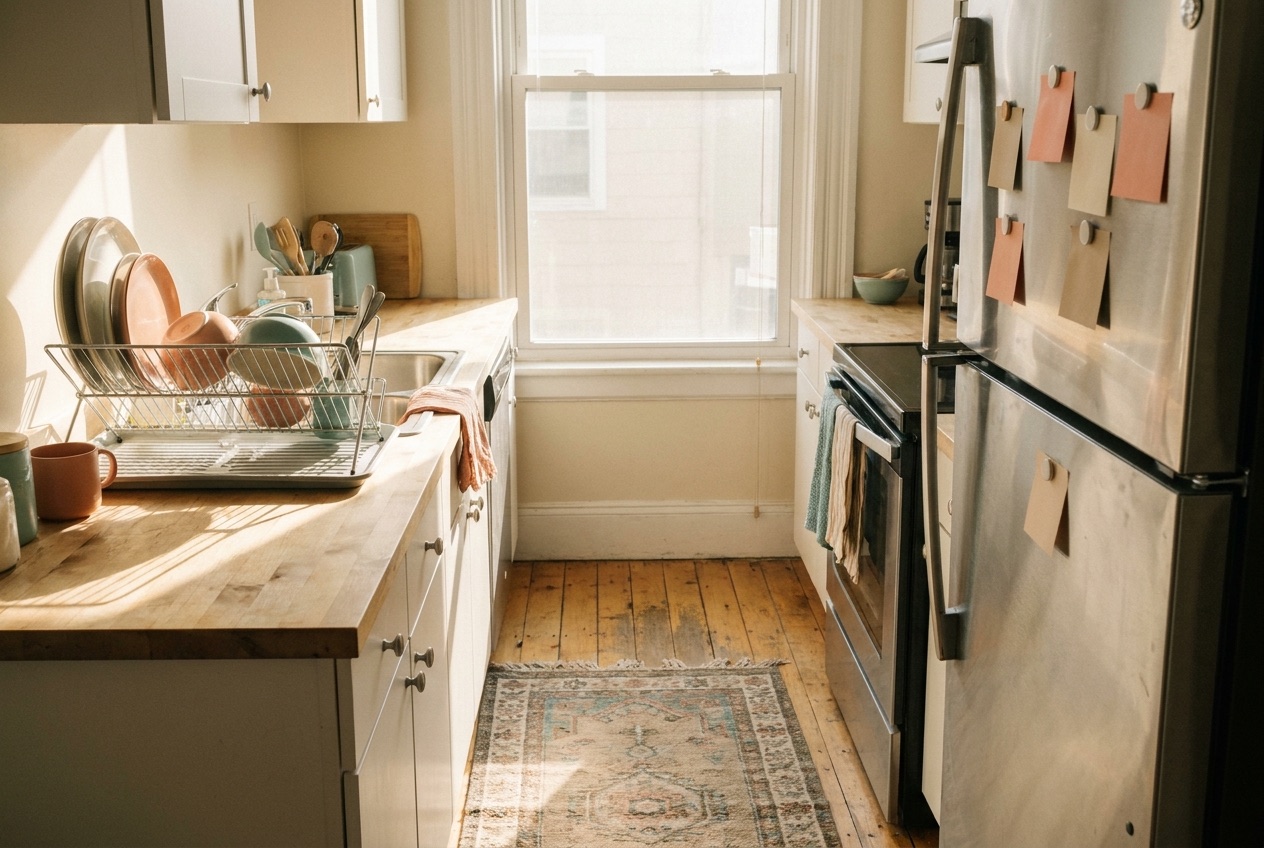
Good shared house etiquette comes down to one habit: treat the spaces you share as if the other people matter as much as you do. Clean up after yourself in real time, keep your noise in your own space, and raise small frictions early, while they're still small. The quiet houses, the happy ones, are almost always the ones where people do these unglamorous things without being asked.
The kitchen is where it starts
More house tension is born in the kitchen than anywhere else, so it's worth getting right. The fridge is the first flashpoint. Most shared houses assign shelf space, and the etiquette is simple: stay in your area, don't eat what isn't yours, and clear out your old food before it turns into a science experiment that everyone can smell. The person who spreads across three shelves and lets things rot is the person the whole house quietly resents, and they rarely realize it's them.
Then there's the sink, and the sink has one rule that prevents most kitchen conflict on its own: wash your dishes when you're done, not later, not tomorrow, now. A sink of someone else's crusted dishes is the single most common complaint we hear, because it's visible, it's daily, and it reads as a small message that your mess is now somebody else's job. Wipe the counter you cooked on. Take your turn with the shared cleaning if the house runs a rotation. None of this is hard. It's just easy to skip when you're tired, and the whole house feels it when you do.
Noise and night shifts
Noise is where consideration gets tested, especially in a house with mixed schedules. Somebody in a shared home is often on a different clock than you, a night-shift nurse sleeping through the afternoon, someone starting work before dawn, and good etiquette means you factor them in even when it's inconvenient. Quiet hours exist for a reason, and honoring them, keeping your music and your calls and your late-night kitchen noise reasonable, is one of the clearest signals that you're a housemate people want to keep.
The night-shift situation deserves special care because it inverts the normal rules. When someone works overnight, their sleep happens in daylight, which means the ordinary daytime racket of a house, a loud call, a blender, a booming TV, lands on them like your neighbor's 3 AM party would land on you. You don't have to tiptoe through your own home, but knowing who's asleep and when, and keeping the truly loud stuff away from those windows, is the kind of small awareness that makes a house livable for everyone in it. Ask your housemates what their schedules are. Most people are glad to tell you, and once you know, being considerate costs you almost nothing.
Guests and partners
Guests are where a shared house's unwritten rules get stress-tested, and where people most often overstep without meaning to. An occasional visitor is normal and fine. The trouble starts when a partner effectively moves in, staying most nights, using the shared spaces and the utilities and the hot water as a resident who isn't on the lease and didn't agree to the house's norms. Now the other housemates are living with a person they didn't sign up for, and the person who invited them usually can't see the problem, because to them it's just their partner.
The etiquette here is honesty and moderation. Know your house's guest policy, because most shared homes have one, and it exists to protect the housemates who are paying to share the space with a known set of people. Have people over, sure, but don't let a guest quietly become an unofficial tenant. If your relationship is heading toward living together, that's a real conversation to have with the house or the operator, not a thing to slide into one night at a time until someone finally snaps. The houses that handle guests well are the ones where nobody has to wonder whether the stranger in the kitchen at breakfast is going to be there every morning from now on.
It's worth naming why this one lands so hard, because people who overstep here almost never think they're doing anything wrong. To the person hosting, it's just their partner, a known and welcome presence. To everybody else, it's an extra body using shared resources they didn't agree to share, changing the feel of the common spaces, and shifting the whole social balance of a home they chose partly for who was in it. Neither view is crazy, which is exactly why guests cause so much quiet friction. The considerate move is to imagine your housemate doing to you what you're about to do to them, and to ask yourself honestly whether you'd be fine with it. Most of good shared house etiquette is just that act of imagination applied before the fact instead of after the argument.
Bathrooms, common areas, and stuff creep
Shared bathrooms run on the same principle as the kitchen: leave it the way you'd want to find it. Clean the hair out of the drain, don't leave your entire routine sprawled across the counter, and be mindful of the hot water in a house where several people shower in the same morning window. A forty-minute shower that leaves everyone after you cold isn't a crime, but it's the kind of thing that turns a housemate into a resented one fast. The bathroom is intimate territory, and small courtesies there go a long way.
Common areas fall to stuff creep, which is the slow, unconscious way one person's belongings colonize shared space. It starts with a jacket on the couch, then it's shoes by the door, then a personal project spread across the dining table nobody else can use anymore. Individually each item is nothing. Together they turn a shared living room into one person's storage unit, and the others stop using a space they're paying for. The fix is just self-awareness: keep your things in your room, and if you use a common area, reset it when you're done so the next person finds it as usable as you'd want it to be.
Packages, parking, and the group chat
The small logistics cause more friction than they should. Packages pile up in the entryway, so grab yours promptly and don't let the shared table become a parcel depot. Parking, where it's tight, runs on unspoken courtesy: don't block someone in, don't take the spot everyone knows is effectively theirs after a long shift, and if the house has an arrangement, honor it. These are tiny things, but tiny things repeated daily are exactly what wears people down or keeps a house pleasant.
The group chat, where a house has one, is a tool that goes bad easily. Used well, it's how you flag that you're out of paper towels, that a repair person is coming, that you'll be traveling for a week. Used badly, it becomes passive-aggressive theater, vague complaints aimed at no one in particular, hoping the guilty party recognizes themselves. That approach almost never works and usually just sours the mood for everyone. If you have a specific problem with a specific person, the chat is the wrong venue. Talk to them directly, which brings up the single most important skill in shared living.
A good rule for the group chat is that it's for logistics and announcements, not for grievances. Announcements are fine and even welcome: a heads-up that you're having two friends over Saturday, a note that the trash goes out tonight, a warning that the hot water's acting up. Grievances aimed at the group in the hope that one person feels targeted are where it curdles, because everyone reads them, nobody's sure who's meant, and the actual offender often doesn't recognize themselves at all. Keep the chat useful and it stays useful. Turn it into a complaint board and people start dreading the notification, which defeats the entire point of having one.
How do you raise a problem before it becomes a feud?
Early and directly, before resentment has time to set. The houses that fall apart are rarely the ones with big dramatic conflicts. They're the ones where small annoyances went unspoken for weeks, quietly compounding, until someone finally exploded over a dish and it turned out to be about a month of dishes nobody ever mentioned. The skill that prevents this is unglamorous and completely learnable: say something the first or second time, kindly, when it's still a minor request and not an accusation.
The tone matters as much as the timing. There's a large gap between a hostile confrontation and never mentioning anything until you snap, and good housemates live in that gap. A calm, specific, early word, hey, could you get your dishes done the same night, I use the sink first thing, solves the problem before it becomes a grudge, because most people genuinely don't realize they're doing anything wrong and are happy to adjust once they know. The people who let things fester until they're furious are usually angrier at themselves for not speaking up. If you truly can't resolve something directly, that's what a good operator is for: someone neutral who can set expectations without it becoming personal between housemates who still have to share a kitchen tomorrow.
Why good shared house etiquette keeps the quiet houses happy
After running shared homes and mediating just about every version of housemate friction there is, the clearest pattern is this: the happiest houses are the quiet ones, and they're quiet because the people in them do the small considerate things without being told to. House rules exist to protect exactly that, not to control anyone or make the place feel institutional, but to hold the baseline of consideration so no single person's carelessness gets to degrade the home for everyone else. Quiet hours protect the sleeper. The guest policy protects the housemates. The cleaning rotation protects whoever would otherwise get stuck doing it all.
None of it works through enforcement, though. It works when people buy into the simple idea that a shared home is shared, that their convenience isn't the only one that counts, and that the small daily acts of cleaning up and keeping it down and speaking up early are what make living alongside others actually pleasant instead of merely tolerable. That's the whole of good shared house etiquette, and it's why the houses where people practice it barely need the rules at all. The rules are a floor, not a ceiling, and the best housemates clear that floor without ever looking at it. We write clear house expectations into our co-living homes for the same reason, not to police anyone, but because a house where everyone knows the baseline is a house where almost nobody has to think about it.