
A Host's Honest Weekend Guide to Atlanta
This is the Atlanta weekend guide we actually text our guests, not the brochure version. The city rewards people who know when to go where and punishes everyone who shows up at the wrong stretch at the wrong hour. It's bigger and more spread out than visitors expect, so a great weekend is mostly about timing and picking the right two or three things instead of seeing everything.
The BeltLine, done right
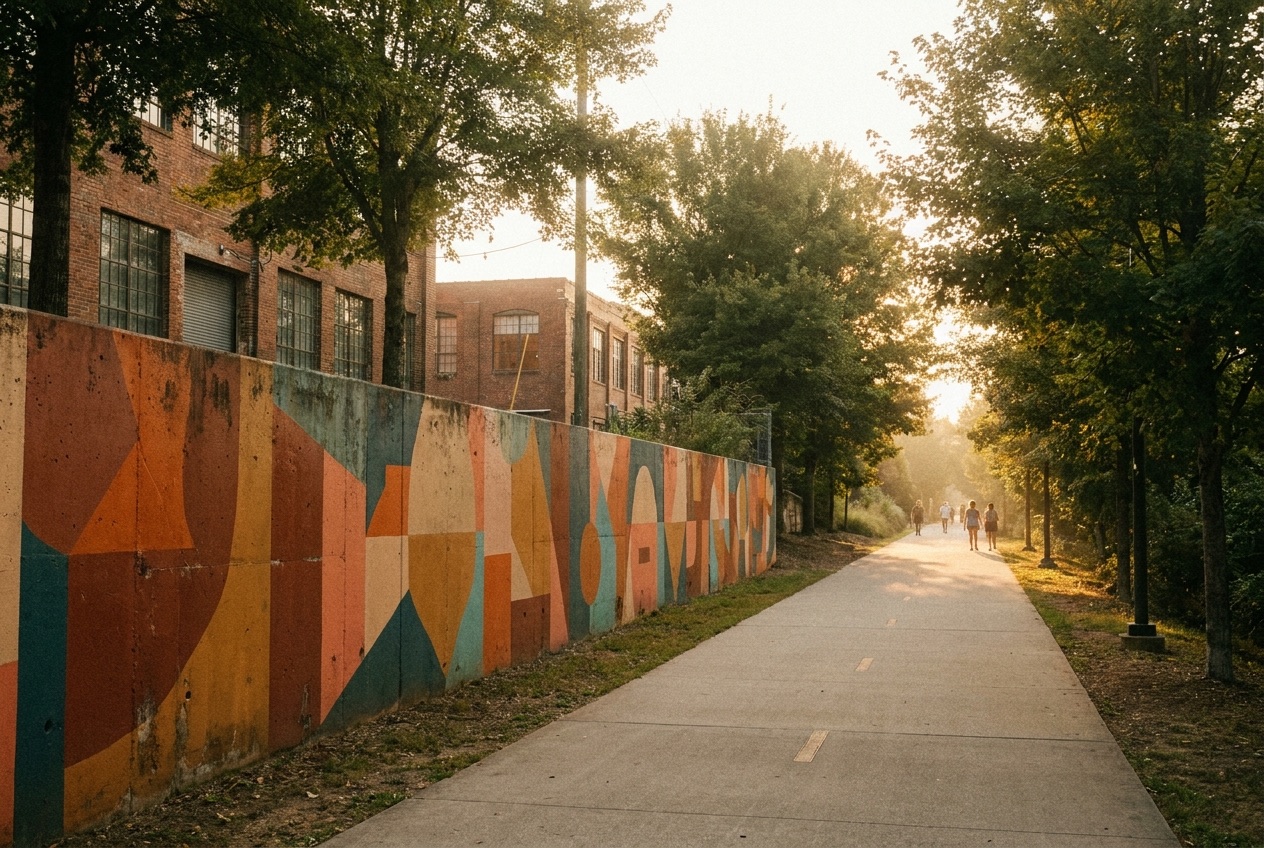
Everybody tells you to walk the BeltLine, and they're right, but they leave out the part that matters, which is which stretch and what time. The Eastside Trail from Ponce City Market down toward Krog Street is the famous piece, and it's genuinely good: murals, patios, people watching, food within arm's reach. It's also mobbed on a sunny Saturday afternoon, shoulder to shoulder, more crowd than charm.
Go early. Get there by nine or ten on a weekend morning and the same stretch is a different place, calm enough to actually enjoy, with the light better for it and the coffee lines short. If you can only go in the afternoon, drift toward the less-trafficked segments away from Ponce City Market, where the crowd thins and you can hear yourself think. The BeltLine's real pleasure is the walking and the neighborhoods it stitches together, and that pleasure evaporates when you're just inching through a human traffic jam taking the same photo as everyone else.
Food halls without the lines
Ponce City Market's food hall is excellent and knows it, which means at peak lunch and dinner you'll spend your appetite standing in lines and hunting a table. The food is worth eating. The experience of eating it at high noon on a Saturday is not, and we'd rather send a guest in with a plan than watch them burn an hour of their weekend on logistics.
The move is to eat off-peak. Show up for a late breakfast or an early, unfashionable dinner around five, and the same hall that felt like an airport at one o'clock feels like a good idea again. Krog Street Market a short walk away is smaller and usually a bit calmer, and it's a solid alternative when Ponce City Market is heaving.
And don't overlook the ordinary neighborhood spots off the halls entirely, the ones locals actually eat at, which serve better food with none of the crowd tax. A food hall is a fun once-a-trip stop, not a reason to stand in three lines. Any Atlanta weekend guide worth the name should tell you the halls are a highlight and a trap at the same time, and the difference is entirely the clock.
The bigger point about eating in Atlanta is that the food scene here is genuinely deep, and it rewards wandering a little off the obvious. Some of the best meals we've sent guests toward were strip-mall spots with no line and no view, the kind of place that would never make a glossy list but has been quietly excellent for years. If you build your whole trip around the two or three restaurants every guide names, you'll eat fine and wait a lot. Ask a local, or ask your host, where they actually go on a Tuesday, and you'll usually do better than the algorithm.
The west side is where we send people who've done the tourist stuff
We're biased because we operate on the west side, but the bias is earned. Westside Park is the newest big one, built around an old quarry reservoir, and it's enormous and still uncrowded compared to the eastside greenspaces, which is exactly why we like it. It's the kind of place you can actually breathe and let a kid run without threading through a festival, and most visitors never hear about it because it isn't on the standard list.
For actual nature, get on the Chattahoochee. The national recreation area strings together river trails and quiet woods on the northwest side, and it's a genuine reset from downtown concrete, close enough that you're on a wooded path twenty-odd minutes after leaving a coffee shop. The Cochran Shoals stretch is the popular access point and it earns the traffic, but there are quieter units up and down the river if you want fewer people. This is the Atlanta most weekend visitors never see, and it's often the part they remember.
The honest pitch for the west side is that it trades a little glamour for a lot of breathing room. You won't find the density of famous restaurants and photo spots that the east side has, and we're not going to pretend otherwise. What you get instead is space, easier parking with shorter lines, and the sense that you're seeing a real working part of the city rather than the version dressed up for visitors. For a lot of our guests, especially the ones on their second or third trip who've already done the postcard stuff, that's exactly the trade they wanted and didn't know to ask for.
Sweetwater Creek over the crowded options
If you have a half day and want one real outdoor thing near where we operate, go to Sweetwater Creek State Park in Lithia Springs. It's a short drive west on the I-20 corridor, and it delivers more than it has any right to: a rushing creek, wooded trails, and the ruins of a Civil War era textile mill you walk right up to on the red trail. That mill is a genuinely striking thing to come around a bend and find, and the trail along the water is one of the better easy hikes in the whole metro.
We steer guests here on purpose instead of toward the more famous crowded spots, because it's closer to the west side, the parking is saner, and on a normal weekend it doesn't feel overrun. Go in the morning if you can, wear real shoes because the red trail gets rocky near the water, and give yourself a couple of hours. It's the honest answer to 'what's a good outdoorsy thing near Douglasville,' and it beats fighting a mob for a lesser view somewhere more famous.
Day-trip candy, with the caveats stated
Two day trips come up constantly, and both are worth doing with clear eyes. Serenbe is a planned community southwest of the city with restaurants, walking trails, and a farm-to-table calm that photographs like a dream. It's genuinely lovely and genuinely small, so treat it as a half-day of walking, a good meal, and a slow browse, not a full-day destination. Go expecting quiet charm and you'll love it. Go expecting a packed itinerary and you'll wonder why you drove out.
Stone Mountain is the other one, and here we'll be straight with you. The park itself is big and the hike up the granite dome is a real, rewarding walk with a wide view at the top. The catch is the carving on the mountain's face, a Confederate monument, and plenty of visitors find that history uncomfortable, which is a fair reaction we're not going to talk you out of.
Our honest take: the natural park and the hike are worth a morning, the commercial attractions bolted onto it are skippable, and you should know what you're looking at on that rock face before you go so it isn't a surprise. Decide for yourself with the full picture, which is more than the tourism copy gives you. A good Atlanta weekend guide owes you the context, not just the pin on a map, and this is one where the context genuinely changes whether you want to go.
The part of an Atlanta weekend guide nobody writes: where not to go
A few honest don'ts, because a good guide says no as often as yes. Don't build a Saturday around fighting traffic to a single far-flung attraction and back, because the drive will eat the day and Atlanta traffic will win. Don't try to cram the eastside BeltLine, a food hall, and a museum into one crowded afternoon, because you'll spend the whole time in lines and cars and enjoy none of it. And be wary of anything that markets itself hard to tourists downtown, where you'll pay premium prices for the privilege of standing in a crowd of other people who also read the same list.
The better Saturday is two or three things, spaced out, timed around the crowds, with room to sit somewhere and do nothing for a while. Atlanta is a city that rewards a slower pace than its size suggests, and the guests who try to speed-run it always leave more tired and less satisfied than the ones who picked a neighborhood, walked it, ate well off-peak, and let the day breathe.
Parking, traffic, and the truths nobody prints
Here's the stuff the glossy guides leave out. Atlanta traffic is not a stereotype, it's a fact of planning, and the difference between leaving at nine and leaving at five can be forty-five minutes each way to the exact same place. Plan your driving around the peaks, treat the interstates as unpredictable, and never assume a short distance means a short drive, because the I-285 perimeter and the connectors through downtown can turn ten miles into an hour without warning.
For parking, the honest advice is to use the MARTA park-and-ride when you're headed into the dense core for a game, a show, or anything downtown, because driving in and hunting a garage there is a special kind of misery. Out on the west side and in the suburbs, parking is easy and free and nobody thinks about it, which is one of the quiet advantages of basing yourself away from the center. Know which Atlanta you're in for the day, the dense one or the spread-out one, and park accordingly.
What's the move on a rainy Atlanta weekend?
Rain doesn't ruin an Atlanta weekend, it just changes the list, and the city has plenty of indoor weight to lean on. The big-ticket indoor attractions cluster downtown, the aquarium and the museums, and a rainy day is exactly when the ticket and the crowd are worth it because everyone's dry and unhurried. Beyond the marquee stuff, the food halls become a genuinely good rainy plan since you're wandering indoors anyway, and the crowd thins when the weather's bad, which flips the usual line problem in your favor.
Our real rainy-day answer, though, is to lean local and low-key: a long lazy meal somewhere good, a bookstore or a coffee shop you can sink into, a movie, the unhurried version of the day. Atlanta rewards this. Not every weekend has to be an itinerary, and some of the best ones here are the slow indoor kind where you never fight traffic once. Wherever you're staying while you explore the west side, the winning move on a wet Saturday is to stop trying to win it and just enjoy being somewhere new with nowhere you have to be.